How to Plan a Low-Carbon Vacation in Costa Rica: Complete Transport & Lodging Guide
Plan a genuinely low-carbon vacation in Costa Rica with this complete guide to eco-friendly transport, certified sustainable lodges, and carbon offset strategies.

By Maya Thornton· Ingénieur thermicien
·11 min read
In this article
TL;DR
- Choose direct flights and offset unavoidable emissions through Gold Standard-certified projects — a round-trip from New York to San José emits roughly 1.1 tonnes of CO₂ per passenger.
- Costa Rica's public bus network (around $1–8 per journey) covers most tourist routes reliably; shared shuttles are a good middle ground between buses and private cars.
- For lodging, look exclusively for CST (Certificación para la Sostenibilidad Turística) ratings of 4 or 5 leaves — the national benchmark backed by the Costa Rica Tourism Board (ICT).
- Manuel Antonio, Monteverde, and the Osa Peninsula offer the densest concentration of CST-certified lodges with direct access to protected natural areas.
- Eating local ('sodas'), hiring community guides, and spending inside protected-area cooperatives keeps your tourist dollar in the ecosystem rather than leaking abroad.
Why Costa Rica Is the Right Canvas for an Eco-Vacation
Costa Rica punches far above its weight in environmental ambition. The country generated 99.8% of its electricity from renewable sources in 2022, a figure confirmed by the Costa Rican Electricity Institute (ICE), powered mainly by hydroelectric, geothermal, wind, and solar. It has also committed to becoming the world's first carbon-neutral country — a target now formally embedded in its National Decarbonization Plan through 2050.
For travelers, this matters in concrete ways. When you charge your phone, ride a public bus, or stay in a lodge on the national grid, the electricity footprint is dramatically lower than in almost any other destination. The challenge is getting there — and moving around once you arrive.
Tourism accounts for roughly 8% of Costa Rica's GDP and supports over 200,000 jobs (Instituto Costarricense de Turismo, 2023). When done right, your visit directly funds the 26% of national territory protected as national parks, biological reserves, and wildlife refuges. When done poorly, it feeds carbon emissions, plastic waste, and the displacement of local communities.
The difference is in the planning details. Here is how to get them right.
Step 1 — Getting There: Minimizing Your Flight Footprint
Choose Your Route Carefully
Flying is almost always the largest single source of carbon in an international vacation. A direct economy-class flight from New York (JFK) to San José (SJO) emits approximately 0.55 tonnes of CO₂ per passenger each way, or around 1.1 tonnes for a round trip, according to ICAO's carbon emissions calculator. Flying from Europe (London, Paris, Madrid) adds roughly 30–40% more emissions per passenger due to distance, even with the most direct routings.
Practical levers to reduce flight emissions:
- Book direct flights whenever possible. A stopover in Miami or Atlanta can add 15–25% more emissions compared to a nonstop.
- Fly economy class — a business-class seat carries a carbon multiplier of roughly 2.9x versus economy on long-haul routes (ICCT, 2021), because it occupies more physical space per passenger.
- Travel in shoulder season (May–June or November) when aircraft tend to fly fuller — seat occupancy directly affects per-passenger emissions.
- Avoid fuel-intensive departure slots — early morning flights on most Latin American routes tend to be newer, more fuel-efficient aircraft.
Offsetting Unavoidable Emissions
Offsetting is not a license to emit freely, but it is a responsible tool when flying is the only practical option. Focus on projects certified by Gold Standard or Verra (Verified Carbon Standard) — avoid cheap, unverified offset schemes that have come under serious scrutiny in recent years (following the Guardian's 2023 investigation into major forestry credit programs).
For Costa Rica specifically, several offset providers fund reforestation directly in-country — meaning your offset money flows back into the same ecosystem you're visiting. Organizations like Fundación para el Desarrollo de la Cordillera Volcánica Central (FUNDECOR) operate verified forest conservation and restoration projects. Budget roughly $20–35 per tonne of CO₂ for credible Gold Standard offsets.
Step 2 — Eco-Friendly Transport Inside Costa Rica
Once you land at Juan Santamaría International Airport (SJO), ground transport decisions determine the bulk of your in-country carbon footprint.
The Public Bus Network: The Low-Carbon Default
Costa Rica has a surprisingly functional intercity bus system operated by private companies under government concession. Key routes relevant to eco-tourists:
- San José → Manuel Antonio: 3.5 hours, operated by Transportes Morales, around $5 per person.
- San José → Monteverde (Santa Elena): 4–5 hours via Tilarán or direct, around $4–7.
- San José → Puerto Jiménez (Osa Peninsula): 8 hours, around $10–12 — the most carbon-efficient way to reach one of the world's most biodiverse corners.
- San José → La Fortuna (Arenal): 4 hours, around $4.
Buses run on diesel, but the per-passenger emissions are a fraction of a private rental car. They also inject money directly into the local economy via drivers, ticket agents, and bus station vendors.
Shared Shuttles: The Practical Middle Ground
For routes that are awkward by public bus — or for travelers with mobility constraints — shared shuttle services such as Interbus and Gray Line offer air-conditioned vans at $25–55 per person per journey. Emissions per passenger sit between a public bus and a private rental car. They pick up from hotels, which removes the challenge of navigating San José's chaotic central bus terminals.
When to Rent a Car — and What to Rent
For the Osa Peninsula interior, remote Nicoya Peninsula beaches, or any destination requiring multiple stops on unpaved roads, a car becomes practical. If you must rent:
- Choose the smallest 4WD that meets your needs — a Suzuki Jimny or similar compact SUV emits far less than a Toyota Land Cruiser.
- Several local operators now offer hybrid rentals (Toyota RAV4 Hybrid is increasingly available at SJO) — ask specifically at Adobe Rent a Car or Vamos Rent a Car, both of which have expanded hybrid fleets since 2022.
- Avoid driving at night — wildlife road mortality is a documented conservation concern in Costa Rica, with species like silky anteaters, ocelots, and sloths regularly killed on poorly lit roads.
Electric Vehicles and Bikes
Costa Rica has one of Latin America's fastest-growing EV fleets — over 22,000 registered electric vehicles as of 2023 (MINAE). Charging infrastructure is concentrated in the Central Valley and the main tourist corridors. EV rentals remain limited but are expanding; EV Rent Costa Rica operates in the San José area. In towns like La Fortuna and Tamarindo, electric bike rentals have emerged as genuinely viable options for day excursions.
Step 3 — Sustainable Lodging: The CST Certification System
Understanding the CST Leaf Rating
Costa Rica's Certificación para la Sostenibilidad Turística (CST), managed by the Instituto Costarricense de Turismo (ICT), is the most rigorous national tourism sustainability certification in Latin America. It evaluates lodges across four dimensions:
- Physical-biological parameters — how the property manages its natural surroundings.
- Infrastructure and services — water use, waste, energy, and construction impact.
- External client management — how guests are educated and engaged.
- Socio-economic environment — contribution to local communities and cultural heritage.
Properties receive 0–5 leaves. Only 4- and 5-leaf properties should be considered by travelers who want substantive sustainability, not greenwashing. As of 2024, approximately 360 accommodations hold a CST certification (ICT database), out of roughly 3,500 registered tourism lodges in the country — making CST a genuine differentiator.
You can search certified properties directly at tourism.co.cr, the official ICT portal.
Sustainable Lodging in Manuel Antonio
Manuel Antonio National Park — one of the country's most visited — sits adjacent to a dense cluster of CST-certified properties.
- Si Como No Resort (5 leaves): A long-standing benchmark for sustainable hospitality on the Manuel Antonio hillside. Wildlife-friendly architecture, grey water recycling, and an on-site butterfly garden. Rates from $280/night.
- Arenas del Mar Beachfront & Rainforest Resort (5 leaves): Certified Blue Flag beach, solar water heating, on-site naturalist guides. Rates from $350/night.
- Hotel La Mariposa (4 leaves): Smaller scale, panoramic views, strong local hiring policies. Rates from $180/night.
Sustainable Lodging in Monteverde
Monteverde's cloud forest region has built its entire tourism identity around conservation — the Quaker community that founded the area in the 1950s created the original private reserve that later became the Santa Elena and Monteverde Cloud Forest Reserves.
- Monteverde Lodge & Gardens (4 leaves): Owned by Costa Rica Expeditions, a pioneer in CST-certified travel. Excellent night walks and community partnership programs. From $160/night.
- El Establo Mountain Hotel (4 leaves): Family-owned since 1990, strong reforestation program, employs entirely from local communities. From $140/night.
Sustainable Lodging in the Osa Peninsula
The Osa Peninsula — home to 2.5% of global biodiversity according to National Geographic — offers the most immersive eco-lodging experience in Central America, though it requires the most travel effort to reach.
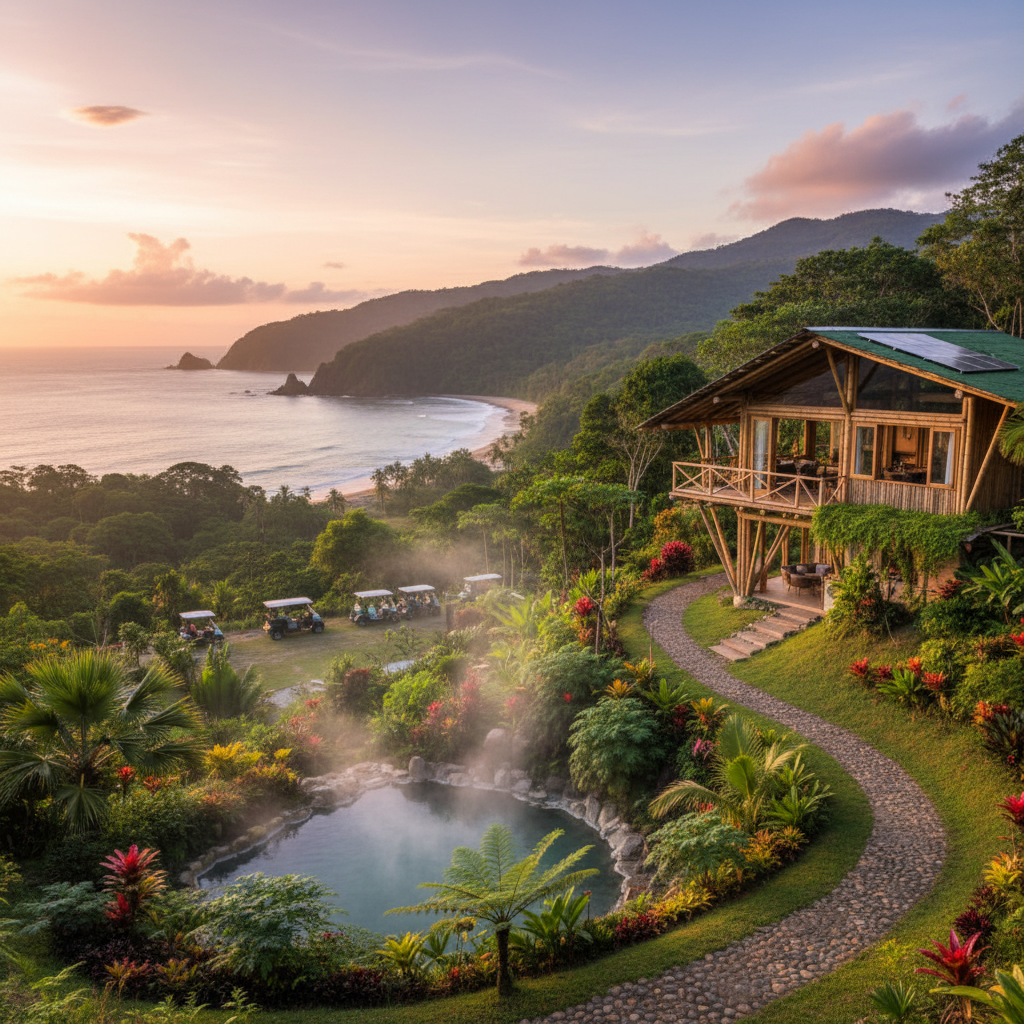
- Lapa Rios Ecolodge (5 leaves): Private 400-hectare rainforest reserve adjacent to Corcovado National Park. Genuine conservation model: the lodge employs 90%+ local staff and has maintained the forest that surrounds it since 1993. From $400/night (all-inclusive).
- Bosque del Cabo Rainforest Lodge: Smaller, solar-powered, on a 300-acre private reserve at the Osa's southernmost tip. From $280/night.
Step 4 — Spending Low-Carbon Inside the Destination
Eat at Sodas
A soda is a Costa Rican family-run restaurant serving traditional casado meals (rice, beans, plantains, protein). Food at sodas is sourced locally by definition of scale and logistics, costs $4–8 per meal, and supports local families directly. Avoiding resort restaurant buffets — which rely on supply chains far longer than a local soda — is one of the most impactful daily decisions a traveler can make.
Hire Community and Park Guides
National parks and many private reserves offer locally trained naturalist guides who are often community members with multigenerational knowledge of the forest. Their fees stay in the local economy rather than leaving to international tour operators. SINAC (Sistema Nacional de Áreas de Conservación) maintains a register of certified park guides for each protected area.
Respect Protected Area Protocols
- Pay park entrance fees — they fund ranger salaries and habitat monitoring (Corcovado: $18/day; Manuel Antonio: $20/day as of 2024).
- Stay on marked trails to avoid soil compaction and wildlife disturbance.
- Do not use chemical sunscreen in or near marine protected areas — use reef-safe mineral-based alternatives.
Building Your Low-Carbon Costa Rica Itinerary: A Practical Framework
A 10-day low-carbon itinerary built around the above principles might look like:
- Days 1–2: San José — acclimatize, visit the Mercado Central, explore the Barrio Amón neighborhood on foot.
- Days 3–5: Manuel Antonio — bus from San José (3.5 hrs), CST-certified lodge, park visits with a registered guide.
- Days 6–8: Monteverde — shared shuttle via Puntarenas ferry route (scenic, no unnecessary highway driving), cloud forest reserves, community cheese cooperative tour.
- Days 9–10: La Fortuna / Arenal — public bus, volcanic hot springs, final night at a CST-certified lodge before returning to SJO by shared shuttle.
This itinerary avoids any domestic flights (which are short but emit disproportionately due to climbing and landing fuel burn), relies on buses and shuttles for all intercity movement, and concentrates spending in CST-certified properties and community-run services.