Cruise Ship Carbon Emissions vs Land-Based Eco-Tourism: A 2026 Data Comparison
How does cruise ship carbon emissions comparison land travel stack up in 2026? Data, verified offsets, and practical sustainable vacation alternatives explored.
By La rédaction de Ecotourism Destinations
·10 min read·Updated
In this article

TL;DR
- A 7-night cruise produces an estimated 1,800–2,400 kg CO₂ per passenger, compared to 400–700 kg for a comparable land-based eco-trip including flights (source IMO, ADEME estimates).
- Maritime tourism accounts for roughly 2.5% of global greenhouse gas emissions — proportionally more per passenger-kilometre than most rail or bus alternatives (source IMO GHG Study 2023).
- Verified offset programs (Gold Standard, Verra VCS) can neutralise residual emissions from both cruise and land travel, but reduction first is the priority.
- Slow travel — fewer, longer trips by lower-carbon modes — remains the most effective personal lever to cut travel emissions significantly.
- Eco-certified land accommodations (LEED, Green Key, Rainforest Alliance) consistently outperform cruise ships on energy, water, and waste metrics per guest-night.
The Carbon Baseline: How Heavy Is a Cruise, Really?
Any honest cruise ship carbon emissions comparison land travel reveals a stark gap: the numbers consistently favour land-based alternatives by a wide margin. The cruise industry frequently markets itself as an all-inclusive, convenient holiday format — and it is. What it does not advertise with equal clarity is its fuel load. The International Maritime Organization's 2023 GHG Study — the most authoritative public dataset available — puts total shipping emissions at roughly 1.1 billion tonnes of CO₂-equivalent per year, with cruise shipping representing a disproportionate share relative to cargo per passenger-kilometre (source IMO GHG Study 2023).
Translated to individual impact: a large cruise ship carrying 3,000 to 5,000 passengers consumes an estimated 150–250 tonnes of heavy fuel oil per day at sea. That translates to approximately 250–420 kg of CO₂ per passenger per day when propulsion, onboard hotel operations, and auxiliary power are combined — based on modelling published by researchers at CE Delft (2023), commissioned by Transport & Environment.
For a 7-night Caribbean or Mediterranean cruise, the per-passenger carbon footprint therefore falls in the range of 1,800–2,400 kg CO₂ (excluding the return flight to the embarkation port, which adds a further 300–800 kg depending on origin).
Why Heavy Fuel Oil Compounds the Problem
Beyond CO₂, around 80% of cruise ships still burn heavy fuel oil (HFO), which releases sulphur oxides, nitrogen oxides, and black carbon — pollutants with additional climate-warming and public-health effects. The IMO's 2020 sulphur cap reduced SOx emissions at sea, but ships operating in Emission Control Areas (ECAs) often switch to scrubbers that discharge pollutants into the water rather than eliminating them (source IMO MARPOL Annex VI).
Liquefied natural gas (LNG) — now fitted on roughly 15–20% of new cruise orders — cuts CO₂ by approximately 20–25% versus HFO and almost eliminates SOx, but methane slip during combustion offsets a portion of those gains (source Transport & Environment, 2023).
Cruise Ship Carbon Emissions Comparison Land Travel: The Full Data Picture
Land-based eco-tourism is not zero-carbon. The honest picture includes flights, ground transport, accommodation, food, and activities. But the architecture of emissions is structurally lighter — and more controllable by the traveller.
Accommodation: Eco-Lodge vs Cruise Cabin
A certified eco-lodge or green hotel consumes, on average, 30–60% less energy per guest-night than a standard hotel — and cruise ships are far from standard hotels. The onboard energy intensity of a cruise ship includes propulsion, air conditioning across a floating city, pools, restaurants, and entertainment venues running 24 hours, with no possibility of switching to the local renewable grid.
The European Environment Agency (EEA) data for tourism accommodation places the average hotel stay at 8–15 kg CO₂ per guest-night for European properties (source EEA Environmental Signals 2022). A Green Key- or LEED-certified property typically sits at the lower end of that range. By contrast, the cruise ship cabin equivalent — taking only the hotel-operations portion of onboard energy — runs closer to 30–50 kg CO₂ per guest-night based on CE Delft modelling.
Ground Transport: The Deciding Variable
The flight to the holiday destination is often the largest single source of emissions for a land-based trip. A return economy flight Paris–Barbados emits approximately 1,600–1,800 kg CO₂ per passenger (source ADEME Base Carbone 2024). That narrows — but does not close — the gap versus a cruise that also requires flying to the port.
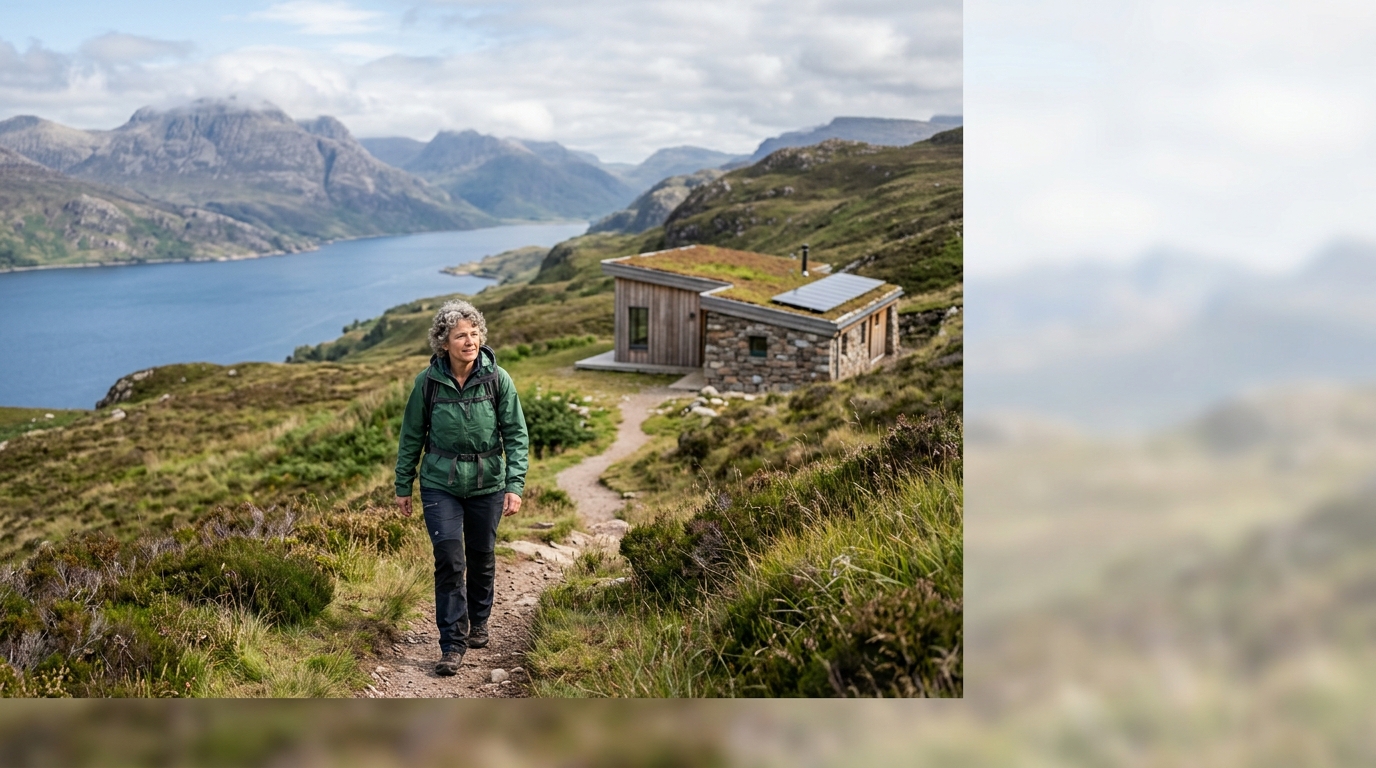
Where land-based eco-tourism pulls decisively ahead is for regional or domestic destinations reachable by train or bus. A 7-night break in the Alps, Scottish Highlands, Portuguese Alentejo, or Costa Rican cloud forest — reached by train or coach — can bring total trip emissions to 150–400 kg CO₂ per person, including accommodation and local transport (source ADEME Base Carbone 2024, EEA).

Head-to-Head: The 2026 Emissions Comparison Table
The table below compares three realistic holiday formats for a traveller based in western Europe, on a 7-night trip.
| Holiday format | Transport emissions | Accommodation emissions | Total estimate |
|---|---|---|---|
| Mediterranean cruise (fly to port) | 1,800–2,400 kg (ship) + 400–600 kg (flight) | Included in ship total | 2,200–3,000 kg CO₂ |
| Caribbean eco-lodge (long-haul flight) | 1,600–1,800 kg (flight) | 60–100 kg (eco-lodge) | 1,660–1,900 kg CO₂ |
| European eco-destination by train | 10–80 kg (rail) | 60–100 kg (eco-lodge) | 70–180 kg CO₂ |
Estimates derived from ADEME Base Carbone 2024 and CE Delft 2023 modelling. Individual results vary by ship class, occupancy rate, distance, and property certification.
The conclusion is unambiguous: a European slow-travel itinerary by train generates 10 to 20 times fewer emissions than a Mediterranean cruise. Even a long-haul eco-lodge trip to a tropical destination emits 30–50% less than a cruise to the same region.
What the Cruise Industry Is — and Is Not — Doing
It would be inaccurate to suggest the sector is standing still. Several measurable shifts are underway as of 2026.
Shore power (cold ironing): An increasing number of European ports — including Hamburg, Barcelona, and Civitavecchia — have installed shore power infrastructure allowing ships to plug into the local grid while docked rather than running diesel generators. The European Commission's FuelEU Maritime regulation (effective 2025) mandates shore power connections for passenger ships at major EU ports by 2030 (source European Commission FuelEU Maritime, 2023).
Alternative fuels: MSC, Carnival, and Royal Caribbean have each announced LNG or methanol-capable ships entering service in 2025–2027. The IMO's revised GHG Strategy (adopted 2023) targets net-zero emissions from international shipping by or around 2050, with a 30% reduction by 2030 relative to 2008 levels (source IMO revised GHG Strategy 2023).
Carbon offsets by cruise lines: Several operators now offer passengers the option to purchase offsets at booking. The quality of these programs varies sharply. Passengers should verify that any offset is certified by Gold Standard or Verra Verified Carbon Standard (VCS) — the two most rigorous independent frameworks — and preferably involves direct removals (reforestation, biochar) rather than avoidance-only credits.
The honest assessment: these measures are meaningful directionally but insufficient to close the gap versus land-based alternatives within the current decade.
Sustainable Vacation Alternatives: Practical Pathways
For a traveller drawn to the cruise format — discovery of multiple destinations, minimal logistics, all-inclusive simplicity — there are land-based equivalents worth considering seriously. If you are ready to explore lower-carbon options tailored to your travel style, find your ideal sustainable itinerary here.
The Rail Grand Tour
Europe's night-train network is expanding. By 2026, direct overnight services connect Paris–Barcelona, Vienna–Rome, Amsterdam–Zurich, and Zurich–Barcelona. A 10-day multi-city itinerary visiting four countries by rail produces an estimated 30–90 kg CO₂ total transport (source ADEME Base Carbone 2024), compared to 2,000+ kg for an equivalent cruise circuit. Rail interrail passes (Eurail) offer comparable pricing flexibility to cruise booking windows. For a deeper look at planning a low-carbon rail holiday, see our complete guide to European slow travel.
River Boat Eco-Alternatives
Small-vessel river tourism — particularly on solar-powered or hybrid electric barges in France, the Netherlands, or the Mekong Delta — offers a maritime-style experience at a fraction of the emissions footprint. Vessels carrying 10–20 passengers with hybrid propulsion emit an estimated 40–80 kg CO₂ per passenger per week, depending on electricity grid mix (internal operator estimates; independent verification recommended).
Ecolodge Circuits
Costa Rica, Rwanda, Bhutan, and Slovenia have built mature circuits of certified eco-lodges connected by low-carbon local transport. Bhutan's high-value, low-volume tourism model — by design limiting visitor numbers — is explicitly constructed to minimise ecological impact per tourist dollar. Browse our curated eco-lodge destination picks to compare options by region and carbon footprint.
How to Offset What You Cannot Avoid
If a cruise is your chosen holiday and you want to take credible action on emissions, the offset route is available — with important caveats.
Step 1 — Calculate accurately. Use a carbon calculator that accounts for cruise-specific emissions, not generic transport averages. The ADEME Bilan Carbone methodology and the Gold Standard footprint tools are reliable references (source ADEME Base Carbone 2024).
Step 2 — Choose verified programs only. Look for projects certified under:
- Gold Standard (goldstandard.org) — highest integrity, includes sustainable development co-benefits.
- Verra VCS (verra.org) — widely used, robust third-party auditing.
- Plan Vivo — particularly strong for smallholder forestry projects.
Avoid unverified in-house airline or cruise-line offset schemes with no independent audit trail.
Step 3 — Prioritise removal over avoidance. Reforestation, enhanced weathering, and biochar projects remove CO₂ already in the atmosphere. Avoided deforestation credits — while valuable — do not remove what your trip emitted.
Step 4 — Budget realistically. At a credible market price of $15–30 per tonne of CO₂ (voluntary carbon market range, 2024–2025), fully offsetting a 2,500 kg cruise footprint costs approximately $37–75 per person. That is a manageable addition to a holiday budget — but it is not a substitute for choosing lower-emission options when they exist.
The Bottom Line for 2026 Holiday Planning
The data is clear and consistent: cruise ships are among the most carbon-intensive forms of leisure travel available, measured per passenger-day. Land-based eco-tourism — particularly within reach by rail or coach — is categorically lighter. Even a long-haul eco-lodge trip to a tropical destination is measurably lower in emissions than a cruise to the same region.
That does not make cruising a moral prohibition. It does mean that a traveller who cares about their carbon footprint should:
- Acknowledge the actual numbers before booking, not after.
- Consider regional slow-travel alternatives as the primary choice.
- If cruising, select newer LNG vessels with shore-power capability — and offset with a Gold Standard or Verra-certified program.
- Avoid greenwashing language from operators that advertise "carbon neutral" cruising without transparent, third-party verified offset chains.
The best sustainable vacation is the one that starts with honest arithmetic.
FAQ
Q: How many kg of CO₂ does a cruise ship produce per passenger per day?
A: Based on modelling by CE Delft (2023) commissioned by Transport & Environment, large cruise ships produce approximately 250–420 kg of CO₂-equivalent per passenger per day when propulsion, hotel operations, and auxiliary systems are combined. The range reflects differences in ship age, size, speed, and fuel type.
Q: Is a cruise worse for the environment than flying to a holiday destination?
A: For most trip durations of 7–14 nights, yes. A 7-night cruise typically generates 1,800–2,400 kg CO₂ per passenger from the ship alone, before adding any embarkation flight. A long-haul return flight (e.g. Europe–Caribbean) emits roughly 1,600–1,800 kg CO₂ per passenger (source ADEME Base Carbone 2024) — comparable or less than the cruise ship component alone, and the flight gets you to a land destination where your daily accommodation footprint is significantly lower.
Q: What is the carbon footprint of an eco-lodge stay compared to a cruise cabin?
A: A certified eco-lodge typically emits 8–15 kg CO₂ per guest-night for accommodation only (source EEA Environmental Signals 2022), versus an estimated 30–50 kg CO₂ per passenger-night for the hotel-operations portion of a cruise ship. Over a 7-night stay, that difference alone amounts to roughly 100–250 kg CO₂ per person in favour of the eco-lodge.
Q: Can I really offset my cruise carbon footprint?
A: You can purchase verified carbon credits to compensate for the emissions — but quality matters enormously. Use Gold Standard (goldstandard.org) or Verra VCS (verra.org) certified projects only, and prefer removal-based credits (reforestation, biochar) over avoidance-only credits. At $15–30 per tonne, fully offsetting a 7-night cruise costs roughly $37–75 per person — meaningful but not a substitute for lower-emission alternatives when available.
Q: What are the most sustainable cruise alternatives for someone who enjoys visiting multiple destinations?
A: The closest structural equivalent is a multi-city rail itinerary. Europe's expanding night-train network allows travellers to visit 4–6 countries over 10–14 days with total transport emissions of 30–90 kg CO₂ (source ADEME Base Carbone 2024) — versus 2,000+ kg for a cruise circuit. Small-vessel river tourism on hybrid or solar-powered boats is another lower-emissions option with a similar pace of discovery.
Q: Are cruise lines making real progress on emissions?
A: Progress is real but modest relative to the scale of the problem. The IMO's revised GHG Strategy (2023) targets net-zero shipping by around 2050, with a 30% reduction by 2030 versus 2008 levels (source IMO 2023). LNG-capable ships reduce CO₂ by approximately 20–25% versus heavy fuel oil. Shore power mandates in EU ports (FuelEU Maritime, effective 2025) will cut docked emissions. None of these measures close the gap versus land-based alternatives within the current decade.
Ecotourism Destinations est édité par ENN Consulting SAS
Recommended reads
More in Carbon offset and responsible travel →
How to Calculate Scope 3 Emissions Tourism
A step-by-step guide on how to calculate scope 3 emissions tourism supply chains, helping tour operators and accommodation managers apply the GHG Protocol framework accurately.

Hotel Breakfast Carbon Footprint & Ecotourism
How much does your hotel breakfast carbon footprint affect ecotourism choices? We break down CO₂ emissions by sourcing model to help eco-travelers decide smarter.

Airline Carbon Offset Programs: How They Work
Curious about airline carbon offset programs how they work? A clear breakdown of offset schemes, CORSIA compliance, and 2026 verification standards—120 to 180 characters.

Airline Carbon Footprint Calculator Accuracy
Airline carbon footprint calculator accuracy varies by up to 300%. Discover which tools are most reliable, why estimates differ, and how to offset your flight CO2 in 2026.